
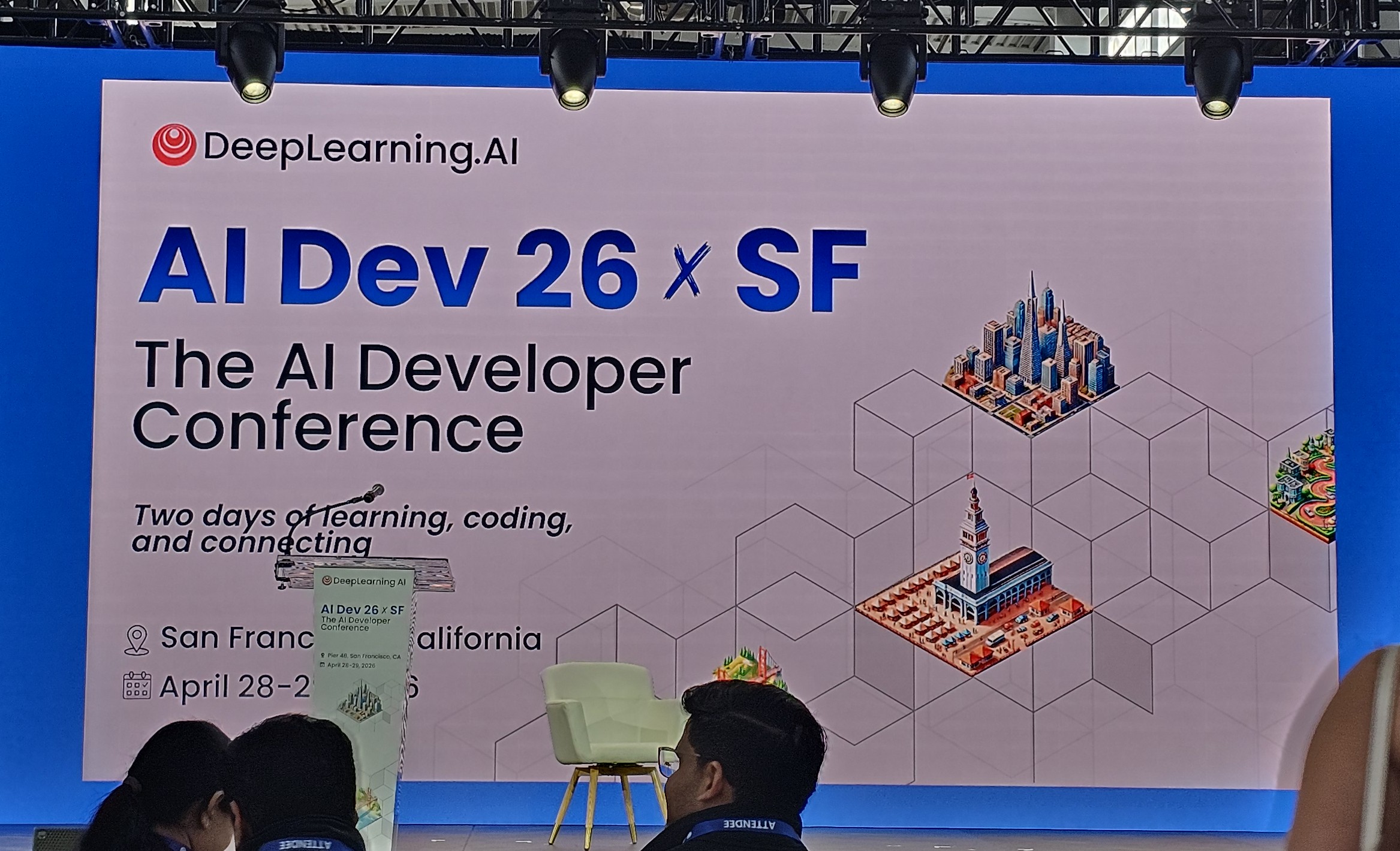
The atmosphere in San Francisco
AI DevWorld 2026 brought together the leading players in the AI industry in San Francisco: OpenAI, Google, AMD, Oracle, Replit and many more. The level of participation and the quality of the sessions reflect how pivotal this moment is for the industry. The energy is tangible, but the tone of the conversation has shifted compared to previous years — fewer product announcements, more production engineering.
The turning point: from prototype to production
The emerging consensus is clear: building an AI agent is no longer the main challenge. Developing a working prototype has become relatively accessible thanks to the maturity of language models and the availability of frameworks. The real complexity lies in the next step — turning an agent that works in a demo into a system that holds up in production, with real data, real users, day after day.
The distinction between "demo" and "production" is the central theme of this phase. Many organisations find themselves stuck halfway: the agent works, but it doesn't scale, isn't reliable enough or isn't controllable enough to deploy with confidence.
The four challenges of production
Discussion across panels and technical sessions converged on four critical areas for bringing agents to production:
Stability and reliability means ensuring consistent performance under variable load, handling failures gracefully and maintaining output quality even at the edges. An agent that works 95% of the time in development can prove unacceptable in production.
Scalability is about handling growing data volumes, concurrent requests and expansion to new use cases without having to rewrite the architecture from scratch. Agentic systems have very different scaling patterns from traditional applications.
Durability and maintainability is the question that anyone responsible for keeping a system running 12 months after deployment must ask: models change, providers update APIs, requirements evolve. A well-built agent must be updatable without being rewritten.
Observability and control is perhaps the most discussed dimension. Knowing what an agent is doing at any moment, being able to verify output quality, intervening when necessary and maintaining security oversight are non-negotiable requirements for organisations deploying these systems.
A rapidly evolving tooling ecosystem
New frameworks and tools designed specifically for these production challenges are emerging at a sustained pace. The ecosystem is specialising: no longer just libraries for building agents, but infrastructure for monitoring, evaluating, updating and controlling them over time. Staying current with this landscape is not a competitive advantage — it is a baseline requirement.
For Aurora, attending events like AI DevWorld is an integral part of the work: bringing back to client organisations the most effective practices and the most up-to-date technology stack, so that every solution we build is designed to last — not just to work in a demo.